
K2 vs K3 Prosthetic Feet: Understanding Mobility Levels

Choosing the right prosthetic foot is an important part of creating a comfortable, functional and safe lower-limb prosthesis. One of the factors prosthetists and orthotists consider when selecting a prosthetic foot is the user's functional mobility level, commonly described using the K-level classification system.Among the most frequently discussed levels are K2 and K3.
But what exactly is the difference between a K2 and K3 user? And does being classified as K3 automatically mean that a person needs a more advanced prosthetic foot?
Let's take a closer look.
What Are K Levels?
K levels are a functional classification system used to describe a person's ability or potential to use a lower-limb prosthesis.
The system ranges from K0 to K4, with higher levels generally representing greater functional mobility and the ability to handle more demanding activities.
Importantly, a K-level is not simply a measurement of how fast someone can walk. It considers the person's ability and potential to perform different types of mobility activities.
K2 – Limited Community Ambulator
A K2 user generally has the ability or potential to walk with a prosthesis and negotiate low-level environmental barriers, such as curbs, stairs and uneven surfaces.
A typical K2 user may be able to walk outside the home but may have limitations when dealing with longer distances, challenging terrain or situations requiring frequent changes in walking speed.
K3 – Community Ambulator
A K3 user generally has the ability or potential to walk with variable cadence and navigate a wider range of environmental barriers.
K3 users may regularly encounter situations such as uneven terrain, crowded environments, multiple stairs, ramps and activities involving changes in walking speed. They may also have work, exercise or recreational activities that require prosthetic use beyond simple walking.
K2 vs K3: What Is the Main Difference?
The simplest way to understand the difference is to think about how much variation and demand the user encounters during everyday mobility.
Feature | K2 User | K3 User |
Typical mobility | Limited community ambulation | Community ambulation |
Walking cadence | Generally more consistent | Variable cadence |
Terrain | Basic outdoor terrain with some barriers | Wider range of terrain |
Curbs and stairs | Can negotiate limited barriers | Can negotiate more demanding barriers |
Uneven surfaces | Some ability | Greater ability |
Community activities | More limited | More extensive |
Work/exercise demands | Usually limited | May require higher prosthetic utilisation |
Prosthetic requirements | Stability and controlled movement are important | Adaptability, responsiveness and energy return may become more important |
The distinction is therefore not simply "basic foot vs advanced foot." The prosthetic foot should be selected according to the individual's functional requirements, clinical assessment and goals.
What Type of Prosthetic Foot Is Suitable for K2?
For many K2 users, stability and predictable performance are important considerations.
A prosthetic foot for a K2 user may need to provide:
Good stability during standing
Controlled rollover
Adaptation to moderate environmental barriers
Comfortable walking at a consistent pace
Appropriate shock absorption
Reliable performance on everyday surfaces
Flexible-keel and multi-axial foot designs are among the types that may be considered for K2-level users, depending on the individual's clinical requirements.
For some users, a foot with greater flexibility or controlled multi-axial movement can make everyday walking more comfortable, particularly when moving between indoor and outdoor surfaces.
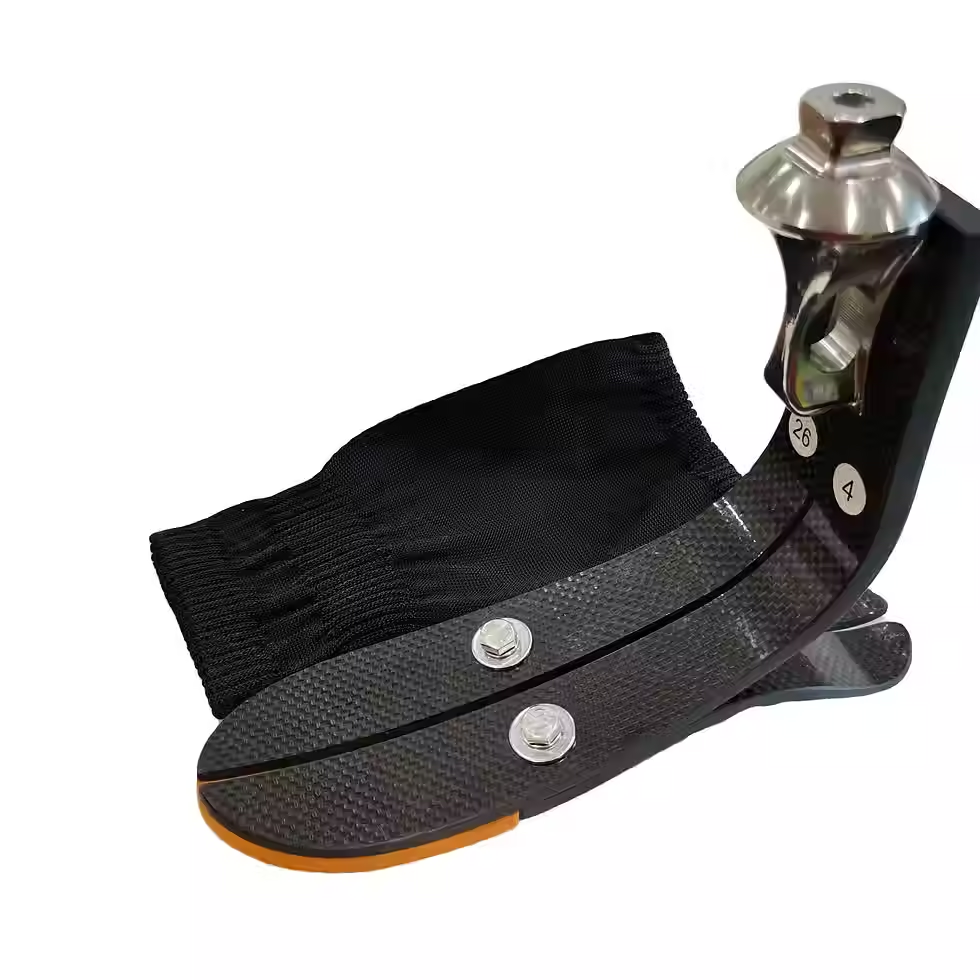
What Type of Prosthetic Foot Is Suitable for K3?
K3 users typically require a prosthetic foot capable of supporting a wider range of activities.
Because K3 mobility involves variable cadence and more challenging environments, the prosthetic foot may need to provide:
Dynamic response
Energy storage and return
Smooth rollover
Greater adaptability
Stability during changes in direction
Performance across different walking speeds
Greater support for recreational, occupational or exercise activities
Energy-storing and dynamic-response feet are commonly associated with higher functional mobility levels such as K3, although the specific prescription should always be based on an individual clinical assessment.
Does a K3 User Always Need a Carbon Fibre Foot?
Not necessarily.
Carbon fibre dynamic-response feet can provide useful characteristics such as energy storage and return, but material alone should not determine the prescription.
The prosthetist or orthotist should consider several factors, including:
Functional mobility
Body weight
Activity level
Walking environment
Residual limb condition
Balance
Occupational requirements
Recreational activities
Patient goals
Socket and suspension system
Overall prosthetic alignment
The goal is not to select the most expensive or most technologically advanced component. The goal is to select a component that is appropriate for the individual's needs.
Can a K2 User Benefit From a More Responsive Foot?
In some cases, yes.
Functional classification is an important consideration, but it is not the only factor involved in prosthetic component selection.
A person classified as K2 may have specific lifestyle requirements, rehabilitation potential or clinical characteristics that influence the choice of foot. Conversely, simply providing a highly dynamic foot does not automatically improve mobility for every user.
The prosthetic foot should work as part of the complete prosthetic system, including the socket, suspension, pylon, adapters and alignment.
Why Proper Assessment Matters
Selecting a prosthetic foot should be more than simply matching a product to a K-level.
A comprehensive assessment can help the clinician understand how the individual actually moves and what they want to achieve.
For example, two people classified at the same K-level may have very different requirements.
One K2 user may primarily walk around the house, local shops and nearby streets. Another may regularly walk on uneven outdoor surfaces and negotiate curbs and stairs.
Similarly, two K3 users may have very different lifestyles. One may require a prosthesis primarily for community mobility, while another may need it for work, exercise or recreational activities.
This is why patient goals and real-world mobility matter.
K2 vs K3: Think Beyond the Label
K-level classification provides a useful framework for understanding functional mobility, but it should not be viewed as the only factor in prosthetic prescription.
The best prosthetic foot is the one that matches the user's:
Mobility + Environment + Activity + Comfort + Safety + Goals
A well-selected prosthetic foot can contribute to improved confidence, smoother walking and greater participation in everyday activities.
For prosthetists and orthotists, understanding the differences between K2 and K3 can help support more informed component selection and patient-centred prosthetic care.
Frequently Asked Questions
Is K3 better than K2?
K3 represents a higher level of functional mobility than K2, particularly in terms of variable cadence and the ability to manage a broader range of environmental and activity demands. However, a higher K-level does not necessarily mean that one person is "better" than another. It describes functional capability and prosthetic requirements.
Can a K2 patient use a dynamic-response foot?
Depending on the individual's clinical situation and goals, a dynamic-response foot may be considered. Component selection should be based on professional assessment rather than K-level alone.
Are all carbon fibre feet designed for K3 users?
No. Carbon fibre is a material, not a K-level classification. Different carbon fibre feet can have different designs, stiffness characteristics, weight limits and functional applications.
Does body weight determine whether someone is K2 or K3?
No. Body weight can influence component selection and appropriate product specifications, but K-level classification is primarily concerned with functional mobility and potential.
Can someone's K-level change?
Yes. Functional ability and potential can change over time. Rehabilitation, changes in health, improved strength, experience with a prosthesis and changes in activity can all influence functional assessment. CMS guidance specifically recognises reassessment when a current prosthetic user's functional capabilities have improved or declined.
Final Thoughts
K2 and K3 represent two important stages of lower-limb prosthetic mobility.
K2 users generally require reliable stability and the ability to manage everyday community barriers, while K3 users typically require greater adaptability, variable cadence and the ability to handle more demanding community, occupational or recreational activities.
Ultimately, choosing the right prosthetic foot is not about choosing the highest specification available. It is about finding the right balance between function, safety, comfort, durability and the individual's goals.
For every prosthetic user, the right component should support one simple objective: helping the person move with greater confidence and independence.
This article is intended for general educational purposes and does not replace an assessment or prescription by a qualified prosthetist, orthotist or other healthcare professional.


Comments